
Tracking Progress and Progress Tracking: Updates from the CLN Steering Committee
The work to update the Conservation Lands Network continues to operate with full wind in its sails, after a summer of progress and decision making. And while that progress and decision making is worthy of celebration, one of the bigger highlights that came out of this summer’s body of work was not totally planned. We built community.
Don’t get us wrong. TOGETHER loves community. But in this season of the CLN where the Project Team needed to produce a lot of deliverables, share those deliverables, and make some decisions on those deliverables – getting chummy over Greek donuts and cups of tea wasn’t on our Bingo card. And, yet, community found a way. And it made the presentation of the body of work that much more celebratory.
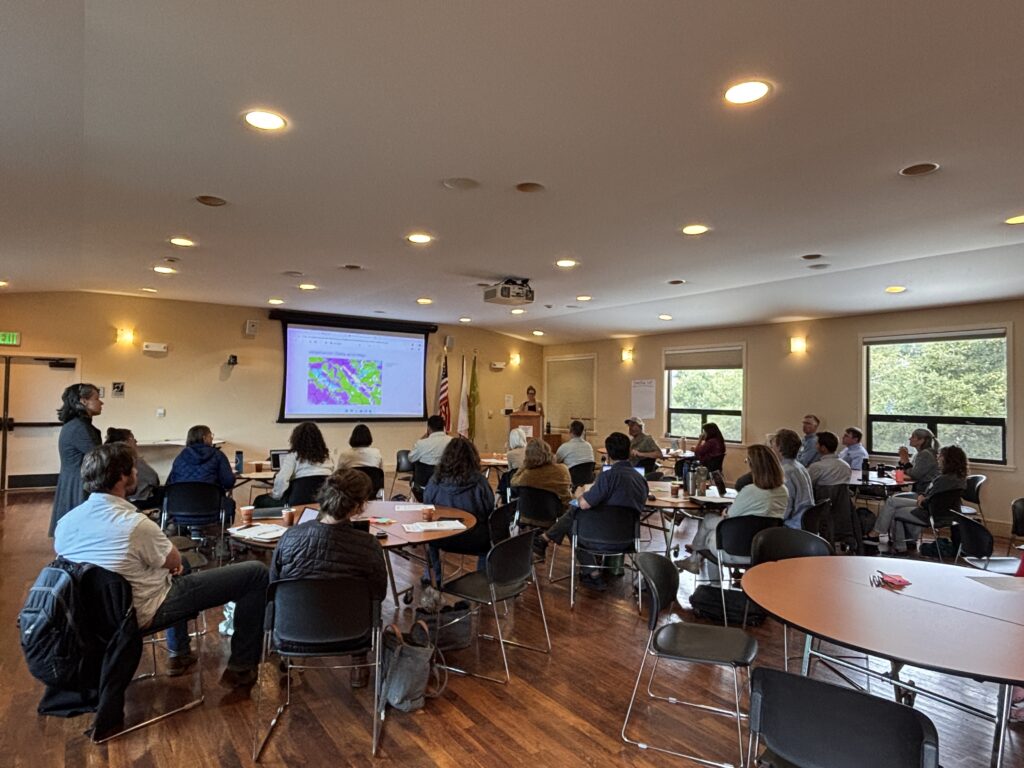
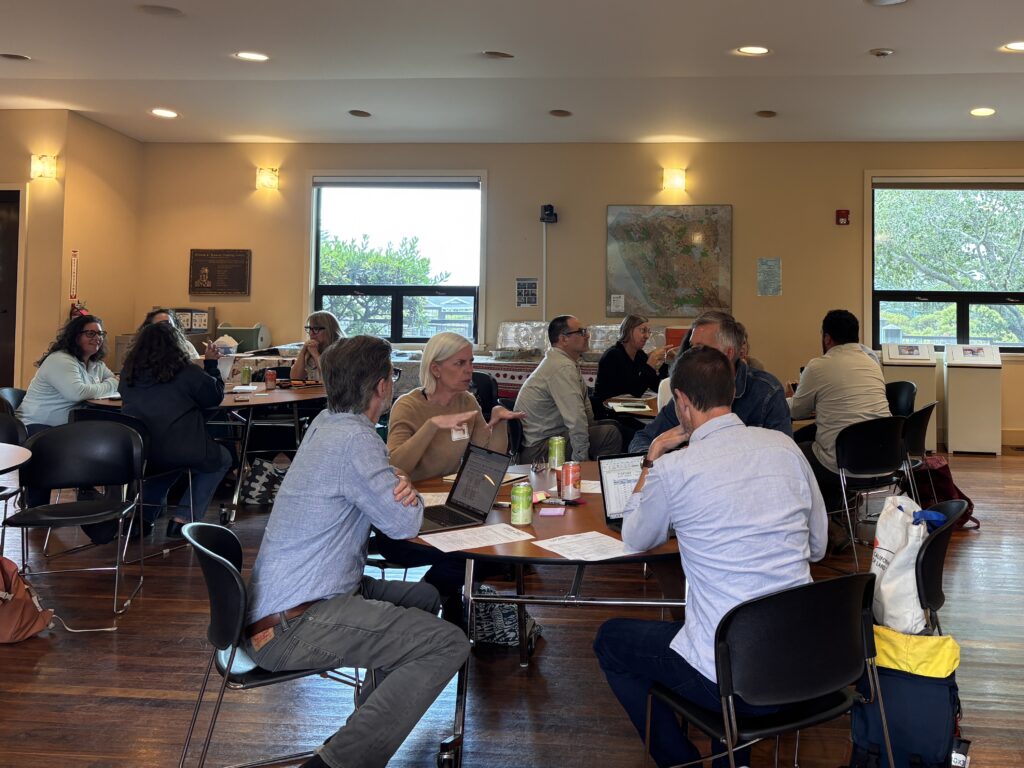
Flanked by cups of tea, delicious donuts, and new work friends, the Conservation Lands Network’s Steering Committee convened in the Oakland Hills on a foggy early September morning to review a large body of work presented by the CLN Project Team. The Steering Committee is comprised of staff representing organizations across the CLN’s 10-county project footprint, from land trust stewardship directors to RCD executive directors to park agency planning staff (scroll down to check out the whole roster).
Together, we saw a complete first draft of a fine-scale vegetation map of the Bay Area including Santa Cruz County that will be used as the foundation for all of the other mapping work that will be completed. We learned how the fine-scale vegetation data that the Project Team is using for this update will crack open our understanding of how health and function of our species and ecosystems are doing in the Bay Area (read: we went from tracking 95 types of vegetation with data used for 2.0 to what we anticipate to be hundreds by using fine scale data). We learned about how Tribal input is being included into the CLN 3.0 Update. And lastly, we made a decision on how the CLN 3.0 Update will integrate stewardship into the CLN 3.0 Report.
It is well-understood that protecting land from development is necessary, but not in itself sufficient, for biodiversity conservation. As it was in CLN 1.0 and 2.0, land stewardship will be further explored as a necessary component of managing for healthy lands in the CLN 3.0 report and database. The CLN must remain a tool that identifies, guides, and supports strategic land acquisition pursuits and projects for biodiversity conservation and ecological resilience. And integrating stewardship into the CLN is an effort to sharpen the tool and be used to further inform the long-term health of and care for those pursuits and projects.
The CLN’s journey to figure out how to do just that has hit peaks and valleys over the last few years. Stewardship is vast, multifaceted, and ever changing. How could a tool – specifically the Conservation Lands Network, with its geospatial mapping capabilities – integrate stewardship in a way that is both effective and meaningful?
Good news. We figured it out.
First, we landed on a definition of stewardship. Here it is:
TOGETHER Bay Area defines land stewardship as being in relationship with the land. And like other relationships, some relationships are healthy and some relationships can also be unhealthy. TOGETHER defines healthy land stewardship as the relational work of tending to healthy ecosystems to emulate and/or enhance ecological function, biodiversity, resilience, cultural, and connection to the land for the long term. One of TOGETHER’s guiding principles is that all lands – natural, working, urban, and rural – need to be stewarded and that people have stewarded lands and waters for thousands of years. Lastly, TOGETHER also believes that healthy stewardship takes place when different activities and treatments function together – from land conservation, to technical treatments, to community-building educational activities – to promote a wide variety of health benefits. Different lands have different needs, and there is no one right way to foster healthy lands, waters, and communities.
Next, we landed on what to do next with that definition.
In the CLN 3.0 Reference Report (like this one), we will tell six to ten stories of effective stewardship practices throughout the Bay Area from different Tribes, Tribal organizations, government agencies, land trusts, and other organizations. The stories will be diverse in the different ways of being in relationship with the land, the types of organizations and partners involved, and the treatments and practices used. Each of the stories will include an estimated total cost of the project or program or partnership being featured, in order to highlight the need to fund this essential work. Private and public land stewardship will be included. And challenges and opportunities will be featured in order to show the complexity and dynamism of land stewardship. In addition to the 3.0 Reference Report, the stories will be profiled on the BayAreaLands.org website.
Presenting how stewardship is taking place across the Bay Area in different stories can be impactful in three different ways. First, collecting stewardship stories across the Bay Area provides tangible representation of all the work that Tribes, Tribal organizations, entities, agencies, and organizations are doing across different practices, at different scales, and in different parts of the Bay Area. Second, to be able to put associated budgets to these projects and programs, it provides both a deepened sense of impact and illuminates the true cost of taking care of the lands and communities in our region. Lastly, stories will be a way to provide more best management practices and memorialize oral histories from long-time stewards or community narratives from community-based organizations.
This is no easy task to tackle. And the CLN Community is ready to continue working hard to get this right, with that same rigor of progress, decision making, and community that we leaned into together on that foggy morning in the Oakland Hills in early September.
This task is in good hands with this esteemed group of people who comprise the Steering Committee. We are so grateful for their leadership and thought partnership.
And we look forward to sharing updates with you along the way. Questions? Send us an email at [email protected].
Shout out to the Conservation Lands Network Steering Committee!
- Alison Forrestel — Division Chief, Natural and Cultural Resources | Golden Gate National Recreation Area
- Allison Schichtel — Senior Conservation Planner | Sonoma County Ag & Open Space
- Becky Bremser — Division Lead for Land Acquisition | East Bay Regional Park District
- Ben Botkin — Senior Program Manager | San Francisco Estuary Partnership/MTC
- Danny Franco — Senior Project Manager | Golden Gate Parks Conservancy
- Emily Corwin — Executive Director | San Francisco Estuary Institute
- James Wilson — Stewardship Director | John Muir Land Trust
- Joe Issel — Director of Stewardship | San Mateo RCD
- Kellyx Nelson — Executive Director | San Mateo RCD
- Kirk Lennington — Natural Resources Manager Midpeninsula Regional Open Space District
- Kyle Pinjuv — Director of Stewardship | Sonoma Land Trust
- Lena Pollastro — Conservation Director | Land Trust of Napa County
- Linda Kwong — Deputy Conservation Manager | Santa Clara Valley Open Space Authority
- Lisa Lomba — Chief Advancement Officer | John Muir Land Trust
- Lisa Lurie — Executive Director | Santa Cruz County RCD
- Mark Bibbo — Conservation Project Manager | Land Trust of Santa Cruz County
- Matt Freeman — Principal | Matt Freeman Consulting
- Matt Gerhart — Conservation Director | Northern Virginia Conservation Trust
- Neoma Lavelle — Principal Planner | East Bay Regional Park District
- Peter Cowan — Director of Conservation Science | Peninsula Open Space Trust
- Rebecca Johnson — Director, Center for Biodiversity and Community Science | California Academy of Sciences
- Sara Press — Senior Manager of Land Protection | Save the Redwoods League
- Tom Gardali — Executive Director | All Hands Ecology
- Tosha Comendant — Sr. Stewardship Program Manager | Land Trust of Napa County
- Tristan Brenner — Stewardship Program Manager | Marin Agricultural Land Trust
- Lydia Lapporte — Coordinator | East Bay Stewardship Network
- Dina Robertson — Wildland Vegetation Program Manager | East Bay Regional Parks District